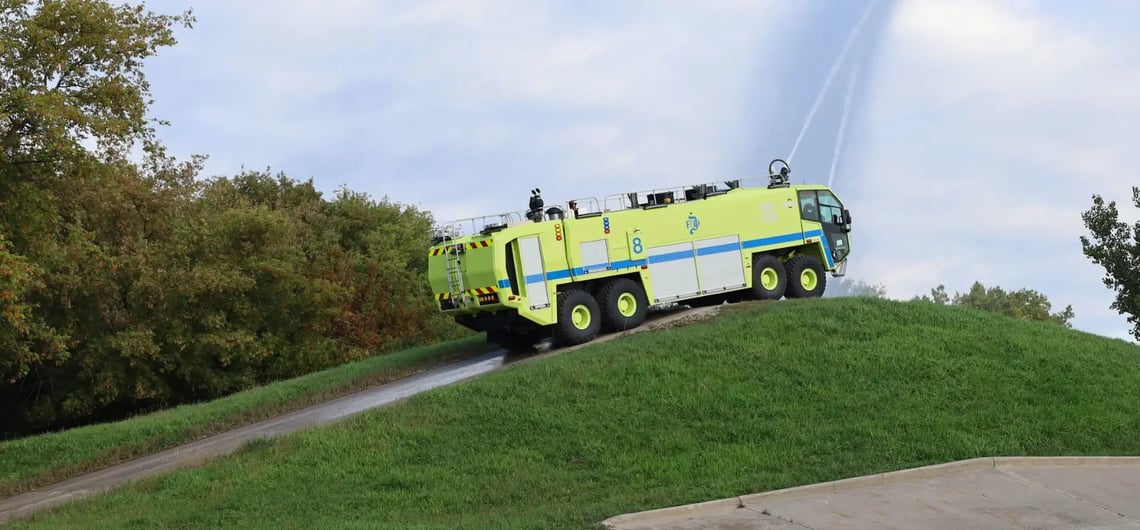
Oshkosh Airport Products conducts a series of tests to ensure its Striker® Aircraft Rescue and Firefighting (ARFF) vehicles meet applicable NFPA 1900 requirements.
NFPA 1900 is a requirement for aircraft rescue and firefighting vehicles, automotive fire apparatus, wildland fire apparatus and automotive ambulances. This establishes requirements for the design, construction, performance and testing of these types of vehicles to support safe, reliable and effective emergency response.
To meet these requirements, Oshkosh Airport Products conducts and documents rigorous testing throughout vehicle development and manufacturing. These tests evaluate critical vehicle capabilities, including stability, gradeability, maneuverability and cooling system performance.
Keep reading to learn how Oshkosh Airport Products tests its Striker ARFF vehicles, including:
- 30-Degree Side Slope Stability
- Gradeability Test – 50% Grade
- Pump and Roll – 40% Grade
- NATO Lane Change
- Cornering Stability
- J-Turn
- Engine and Transmission Cooling Tests
- Prototype and Operational Tests
Note: Previously, requirements for aircraft rescue and firefighting (ARFF) vehicles and other fire apparatus were outlined separately under NFPA 414 and NFPA 1901. In 2024, these requirements were consolidated into NFPA 1900.
Learn more about NFPA Requirements.
30-Degree Side Slope Stability
NFPA 1900 requires fully loaded ARFF vehicles to meet a 30-degree side slope stability requirement. This test evaluates a vehicle's center of gravity, stability and resistance to rollover, helping ensure safe and reliable operation when navigating uneven terrain during an airport emergency response.
All Oshkosh Airport Products ARFF vehicles are tested on a tilt table that complies with SAE J2180. During testing:
- The tilt table must have a high-friction surface.
- Vehicle tires cannot contact the slip rails.
- The vehicle must be positioned squarely on the table.
- The vehicle is tilted in both directions.
The ARFF vehicle must remain flat on the tilt table until inclined 30 degrees before the upper tires leave the surface of the tilt table.
Gradeability Testing
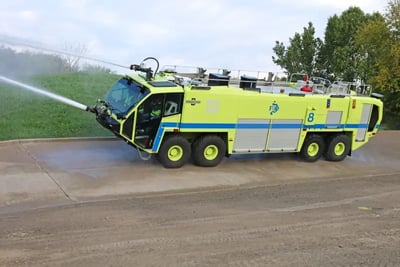 Under NFPA 1900 requirements, the driveline in ARFF vehicles must be capable of climbing a 50% grade and performing pump and roll operations on a 40% grade. Meeting these performance requirements can be challenging due to the weight of ARFF trucks, which carry large quantities of firefighting agents and equipment.
To achieve the necessary power and traction, ARFF vehicles are typically equipped with high-horsepower engines (often 16-liter engines producing 670 to 770 horsepower) and transmissions designed to handle heavy loads and steep inclines.
To verify these capabilities, ARFF vehicles undergo gradeability testing on an actual incline or through a simulated test using the drawbar method. Oshkosh Airport Products uses the drawbar method to evaluate the performance of its Striker ARFF vehicles under fully loaded conditions.
- 50% Gradeability Test: The Striker ARFF pulls another vehicle connected by a tow chain equipped with a load cell. The load cell measures the pulling force, allowing the team to simulate the resistance associated with climbing a 50% grade.
- 40% Pump-and-Roll Test: The Striker ARFF discharges water while performing the drawbar test, demonstrating its ability to operate the firefighting system while overcoming the resistance associated with a steep incline.
NATO Lane Change Test: Evaluating Vehicle Handling
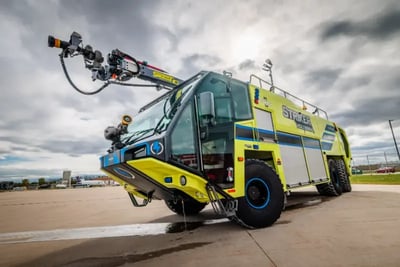 The NATO Lane Change test evaluates an ARFF vehicle's dynamic stability and handling during sudden directional changes, such as maneuvering around obstacles during an airport emergency response.
The test measures how the vehicle responds to lateral acceleration, a force that can increase rollover risk during sharp turns. The Oshkosh Striker ARFF vehicle's low center of gravity helps maintain stability and provides a smoother, more controlled ride while meeting NFPA 1900 performance requirements.
To conduct the test, Oshkosh Airport Products sets up a course based on the vehicle's dimensions, using cones to simulate lane changes in both directions. The fully loaded Striker ARFF must navigate the course at a fixed speed of 35 mph (56 km/h) without knocking over any cones or losing speed to successfully complete the test.
Want to see how the Oshkosh Striker ARFF has evolved over the years? Check out our blog on the evolution of the Striker ARFF.
Cornering Stability
In addition to the NATO Lane Change test, NFPA 1900 outlines turning circle and J-turn tests to evaluate an ARFF vehicle's maneuverability and stability during turns. These tests assess how well a fully loaded vehicle maintains control while navigating curves at specified speeds.
- Turning Circle Test: The ARFF vehicle drives in a 100-foot (30.5 m) circle, gradually increasing its speed to 22 mph (35.5 km/h) while maintaining a fixed steering wheel position.
- J-Turn Test: The ARFF vehicle travels in a straight line before navigating a curve at a set speed of 30 mph (48 km/h) to evaluate its stability during a sudden directional change.
Both tests are performed with the vehicle loaded to its gross vehicle weight rating (GVWR), using the truck's load rack and safety outriggers during testing.
To further enhance maneuverability, the Oshkosh Striker 6x6 ARFF can be configured with rear-wheel steering, which helps improve turning performance and reduce tire wear.
Engine and Transmission Cooling Tests
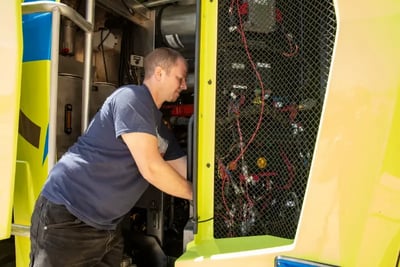 NFPA 1900 requires major components of the vehicle to be certified by the supplier. The two most complex items to certify are the engine and transmission. Engine and transmission suppliers have specific criteria which need to be followed for proper installation.
The cooling system plays a critical role in regulating engine and transmission temperatures, helping prevent overheating and oil breakdown. Cooling systems typically consist of an air cooler, fan drive, flow source and regulation control. Ambient air influences the cooling system design. According to NFPA 1900, ARFF vehicles are required to operate from 32°F to 110°F (0°C to 43.3°C). When designing these cooling systems, ARFF manufacturers must consider areas of the world where temperatures above this threshold occur.
Once the cooling system is installed, Oshkosh Airport Products conducts testing to verify the engine and transmission operate within the manufacturers' specified parameters.
Using a water brake dynamometer, the team applies a controlled load to the engine and transmission to simulate vehicle operating conditions. Oshkosh also uses an internally developed data acquisition system capable of recording approximately 90 channels of data, including:
- Coolant temperatures
- Engine and transmission oil temperatures
- Component temperatures
- Airflow rates
- Coolant flow rates
This data helps Oshkosh verify cooling system performance, confirm proper engine and transmission operation and validate that the installation meets supplier requirements.
Prototype vs. Operational Tests
ARFF vehicles undergo two types of testing outlined by the NFPA: prototype testing and operational testing. Both help verify that ARFF vehicles meet applicable performance and safety requirements, but they serve different purposes.
Prototype Testing
Prototype testing is conducted when a new ARFF vehicle is developed to verify that its design meets applicable NFPA performance requirements. Under NFPA 1900, these tests evaluate:
- Vehicle Performance: Assessing driving capabilities, stability and overall vehicle performance.
- Firefighting Operations: Verifying the performance and functionality of firefighting systems.
- Component Certification: Confirming that key vehicle components meet applicable certification requirements.
Prototype testing is required for the first vehicle produced of a new design. Additional testing may be necessary if significant design changes are introduced.
For example, if a new engine is installed, the manufacturer may need to repeat driving performance tests but may not need to repeat testing of the dry chemical system.
Operational Testing
Unlike prototype testing, operational testing is performed on every ARFF vehicle produced before delivery to the customer. Where prototype tests confirm the overall design meets the requirements of the NFPA, operational tests confirm each truck is built to meet the requirements of NFPA 1900. This helps ensure each truck individually is compliant before it is put in service by the customer.
Operational tests are essentially an abbreviated battery of prototype tests that are better suited to testing in the production environment. For example, operational tests may be performed in the “Fully Loaded” configuration for the individual truck rather than the GVWR for the platform.
Through comprehensive prototype and operational testing, Oshkosh Airport Products works to verify that every Striker ARFF vehicle meets applicable performance and safety requirements during airport emergency response.