.webp)


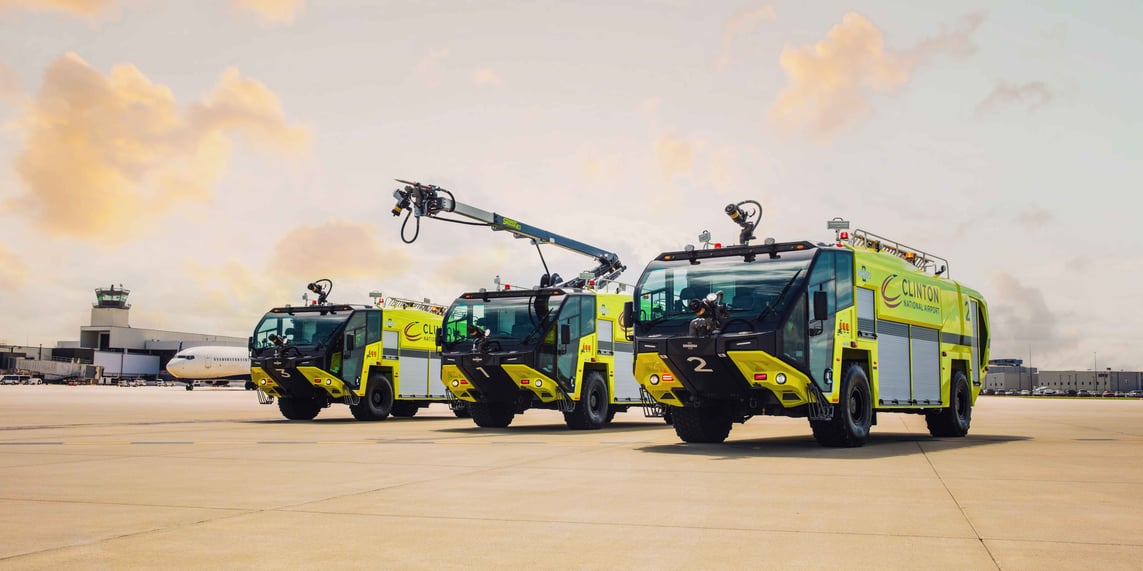
Purchasing an Aircraft Rescue and Firefighting (ARFF) vehicle isn’t an everyday purchase. For many airports, it’s a once-in-a-decade investment, requiring an understanding of Federal Aviation Administration (FAA) regulations, federal funding and the unique needs of the airfield.
In this article, Travis Ownby, a longtime Oshkosh Airport Products Sales Representative at Siddons-Martin Emergency Group, shares a behind-the-scenes look at each stage of the ARFF purchasing process -and how the Oshkosh Dealership Network has made it more personal, efficient and customer-focused than ever before.
Step 1: It Starts with a Conversation
For most airports, the ARFF sales process begins with a simple question: What do we need?
This question leads to a needs assessment, a collaborative discussion between the airport’s personnel and their local Oshkosh Airport Products Dealer to identify operational priorities, future growth plans of the airport and the resources available to support the purchase. During this stage, dealers help define everything from staffing levels and typical response scenarios to airfield layout and mutual aid coverage.
“Your local Oshkosh Airport Products Dealer is your go-to ARFF expert. You wouldn’t build a house without an architect or designer, and that’s what we are for airports. We help them design the best possible ARFF vehicle for their needs.” — Ownby
Understanding Airport Indexes
The FAA sets the standards for ARFF vehicles and staffing requirements through an airport’s index classification, which is based on aircraft size and flight frequency. The larger the aircraft and busier the airport, the higher the index and the greater the requirements for fire protection and equipment.
For large commercial airports with established fire departments, the needs assessment often focuses on keeping their fleets compliant and up to date. For smaller or regional airports, dealers play a critical advisory role, helping teams navigate changes in the regulatory environment, such as evolving foam requirements, while evaluating vehicle options that maintain compliance now and in the future. This guidance is especially valuable for airports that may only purchase an ARFF vehicle once every decade.
Looking Into ARFF Funding
Because airports operate under a combination of federal oversight and local management, funding and compliance are critical considerations when building an ARFF spec for purchase. Federal guidelines ensure airports can respond effectively to commercial aircraft emergencies, but they also influence how an airport plans, funds and ultimately procures its ARFF vehicles.
How Dealers Help Align Funding and Vehicle Specifications
Airports ultimately choose to work with experienced ARFF dealers because they understand how to translate operational, regulatory and budget requirements into a vehicle specification tailored to the airport’s unique needs. Whether an airport is replacing an existing truck or planning for future growth, dealers help evaluate index requirements, operational realities and long-term readiness before a specification is finalized.
This guidance is especially valuable for airports which may only build an ARFF vehicle specification once every decade. By working closely with the airport early in the process, dealers help ensure the selected configuration aligns with both compliance requirements and available funding.
Leveraging AIP and Federal Funding Programs
Many airports fund ARFF vehicles through the FAA’s Airport Improvement Program (AIP), which helps smaller and regional airports leverage federal funding for critical safety equipment. For airports exploring how to buy an ARFF truck with AIP fund support, these programs can also be combined with other federal, state or local funding sources, allowing airports to pursue the right ARFF vehicle while continuing to work directly through their dealer.
It's important to remember, while AIP funding can support the purchase of a great ARFF truck, it is tied closely to FAA requirements, which may limit an airport’s ability to customize the vehicle around its unique operational goals. By working with a dealer early in the process, airports can build a specification that meets FAA compliance while still tailoring key features, performance needs and long-term readiness to their airfield.
Oshkosh Airport Products supports this process with subject matter experts who understand AIP requirements and can help guide airports and dealers through the funding process. This expertise helps airports navigate eligibility, timing and documentation requirements, ensuring funding aligns with the goal of building an ARFF spec for purchase that meets the airport’s needs today and into the future.
“Federal funding has always played a major role in airport operations. But some airports fund their ARFF vehicles locally, just like a city buying a municipal fire truck. It really depends on the size of the airport and how it’s managed.” — Ownby
Need an ARFF vehicle with a quick turnaround? Check out our stock truck options.
Step 2: Turning Needs into Specifications
Once an airport’s needs are defined, the next step is translating them into a detailed ARFF vehicle specification.
This is where the process becomes more technical. Seating configurations, lighting options and specialized tools, like the Oshkosh® Snozzle® High-Reach Extendable Turret (HRET), are discussed and finalized. While ARFF vehicles offer less flexibility for customization than municipal fire trucks, there’s still room to tailor key features to meet each airport’s operational requirements.
Today, this step is faster and more collaborative thanks to Oshkosh’s Pulse configuration tool, which allows dealers to adjust layouts, options and pricing in real time with customers.
“We can make changes instantly with the customer sitting right there. It’s been a game changer for speed and efficiency.” — Travis Ownby
By combining Oshkosh’s engineering expertise with local dealer insight, the specification process has become more transparent, interactive and responsive, helping airports move from concept to configuration in a fraction of the time.
Check out the top five key features of a Striker ARFF Vehicle here!
Step 3: Preconstruction Review
When the design is complete and confirmed, the order is sent to the Oshkosh Airport Products facility. Before manufacturing begins, the airport, dealer and Oshkosh Airport Products' engineering team meet for a preconstruction review.
This is the moment to confirm every detail, including equipment placement, cab layout, color schemes and any last-minute updates. Once approved, the apparatus is assigned a job number and the build moves to production.
Step 4: Manufacturing the Vehicle
Throughout the manufacturing process, the airport and dealer stay connected through regular progress updates. Dealers act as the customer’s primary point of contact, sharing milestone information such as chassis completion, body assembly, paint and system integration.
Behind the scenes, the truck moves through a series of highly specialized stations where components are assembled, tested and quality-checked to ensure the vehicle meets performance standards. By the time the build is complete, every system, from the pump to the electrical controls, has been inspected and verified internally before the customer ever sees the vehicle.
Get an inside look at the Striker ARFF Vehicle.
Step 5: Inspection and Delivery
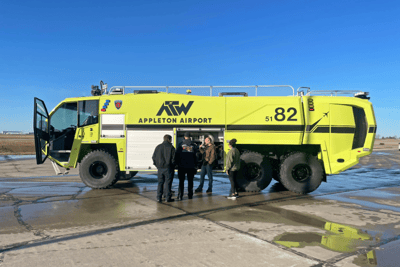 When the truck is complete, the customer and dealer are invited to the Oshkosh Airport Products facility for a final inspection. This hands-on review usually lasts a full day and allows everyone involved to walk through the vehicle in detail, confirming layout, testing systems and verifying every agreed-upon specification has been met.
The dealer and Oshkosh Airport Products team guide the customer through functional checks, demonstrating everything from lighting and pump performance to cab controls. This collaborative process ensures complete alignment before the truck leaves the factory floor.
“As dealers, we’re the customer’s advocate. If they need anything or request anything, we’re there to help. Our job is to make sure they get exactly what they expect from their ARFF vehicle.”— Ownby
Step 6: Hands-On ARFF Vehicle Training
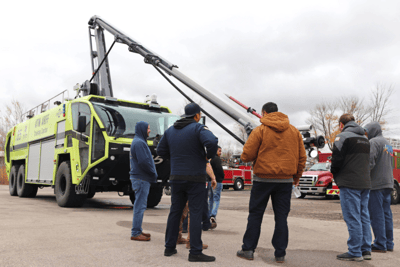 Once the inspection is approved, the ARFF vehicle is prepared for shipment and transported to its new home. Upon arrival, the dealer provides on-site in-service training, typically spending three to four days with the airport’s fire crew.
During this time, the team learns how to operate and maintain the truck, covering everything from daily checks and fluid levels to system functions and safety procedures. If you’re looking for more in-depth training, Oshkosh Airport Products also offers private and custom training sessions at its headquarters or at your airport.
Get an inside look at what to expect during a visit to Oshkosh Airport Products.
Step 7: Support After ARFF Vehicle Delivery
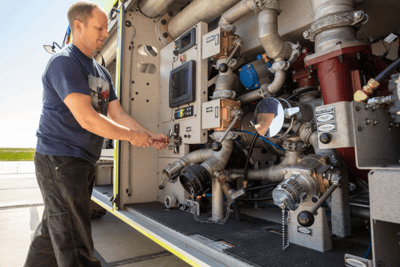 Once an ARFF vehicle is on site and in service, the dealer continues to serve as the airport’s primary contact for warranty coordination, maintenance and technical support. Backing this local support is Oshkosh Airport Products’ global network of highly skilled service technicians, enabling rapid response and helping ensure maximum vehicle uptime.
Instead of contacting a central service center, airports can now reach out directly to their local dealer who sold and understands their vehicle. The result is faster communication, shorter turnaround times and a more personal experience.
Dealers also assist with warranty claims, coordinate with Oshkosh Airport Products when replacement parts are needed and ensure each vehicle continues to perform at optimal readiness throughout its lifecycle. With about 95% of parts shipping the next business day, airports benefit from minimal downtime and faster returns to full operational readiness.
“We develop a strong partnership with our customers during the sales process, which lasts well beyond delivery. And because we are local, our customers know we are there to answer the call and provide any service or help as soon as possible.” — Ownby
Your local dealer is your advocate throughout the sales process and the entire lifespan of your ARFF vehicle. The same people who guided you through the ARFF sales process are the ones you can count on whenever you need them.
Have more questions about service and support? Click here.
Redefining the ARFF Purchasing Experience
From the first needs assessment to final delivery and ongoing support, purchasing an ARFF vehicle is a detailed and collaborative process. Each step depends on clear communication between the airport, the dealer and the Oshkosh Airport Products team to ensure every vehicle meets the highest standards of performance and compliance.
Today, the process is more seamless than ever thanks to the Oshkosh Airport Products Dealership Network. Airports now have a local advocate who understands their unique operations, provides guidance at every stage of the ARFF vehicle sales process and remains a trusted partner long after delivery.
Ready to start the process? Connect with your local Oshkosh Airport Products Dealer.