.webp)



As airports transition to fluorine-free (F3) foam, many ARFF teams are asking the same question:
How do we update our existing apparatus to meet new requirements?
While the shift to F3 foam is a major step forward for environmental responsibility, it also requires a thoughtful, step-by-step approach to ensure your ARFF vehicle continues to perform when it matters most.
In this guide, we’ll explore why the industry is moving to F3 foam and walk through the key steps involved in transitioning your existing ARFF fleet.
With the Oshkosh Dealer Network and Technical Support Teams available to support the process on-site, your department doesn’t have to navigate the transition alone.
Why the ARFF Industry Is Moving Away from AFFF Foam
For decades, Aqueous Film Forming Foam (AFFF) has been the industry standard for ARFF operations due to its ability to quickly suppress fuel-based fires. However, AFFF contains a class of chemicals known as PFAS (per- and polyfluoroalkyl substances), often referred to as “forever chemicals” because:
- They do not break down naturally in the environment
- They can accumulate in soil and groundwater
- They have been linked to serious health concerns, including cancer and other long-term effects
Because of these environmental and health risks, regulatory agencies and airports are working to phase out AFFF and transition to a safer alternative.
Transition to F3 Foam with an Existing ARFF Fleet
F3 foam has different physical properties than traditional AFFF, particularly its higher viscosity. These differences can affect how foam flows through the system and how it is proportioned during discharge. Because of this, transitioning to F3 foam involves more than simply draining one agent and refilling another.
The transition process typically includes:
- Removing and disposing AFFF and cleaning any remaining AFFF from the system
- Adjusting mechanical foam proportioning as needed, based on output test results (no adjustment is needed with the Oshkosh® ECO EFP™ system)
- Verifying foam output and concentration through testing
- Cleaning and disposing of foam after output testing
Oshkosh has worked closely with the FAA over the past several years to thoroughly understand the F3 foam transition requirements. We have worked closely with some of the leading airports through their transition, including Chicago O’Hare, Portland International and Cincinnati/Northern Kentucky International. We have also partnered with Dallas Fort Worth (DFW) and Solberg Airport to perform extensive foam testing.
The Oshkosh Dealer Network and Technical Support Teams are available to assist with every stage of the F3 foam transition process—from system cleaning to calibration and testing—helping departments transition with confidence.
Step 1: Cleaning PFAS (AFFF) from Your Foam System
Before introducing F3 foam, it’s important to understand that simply draining your existing AFFF system isn’t enough. PFAS (the “forever chemicals”) from AFFF can adhere to the internal surfaces of tanks, hoses, piping and proportioning components. Even after draining, these residues can remain trapped inside the system and potentially contaminate new foam if not properly removed. Because of this, a thorough cleaning and preparation process is a critical first step in any F3 transition. Reach out to your local environmental agency/leader to determine the best path for your airport.
Step 2: Dialing in the System for F3 Foam
 Once the foam system is clean, the next step is ensuring your ARFF vehicle delivers the correct foam-to-water ratio with the new F3 foam.
Because F3 foam is generally more viscous than traditional AFFF, it flows differently through the system. As a result, some modifications may be required to maintain proper foam concentration and overall system performance.
This process includes:
- Measuring water flow rates at each discharge
- Performing an input-based test to verify foam percentage and determine if modifications are required
- Verifying foam output and concentration through testing
- Modifying system elements—such as increasing metering orifice sizes—to achieve proper foam flow
- If desired, use a foam surrogate to dial in the foam percentage further based on the foam manufacturer you intend to use.
The type of foam proportioning system on your vehicle plays a key role in this process: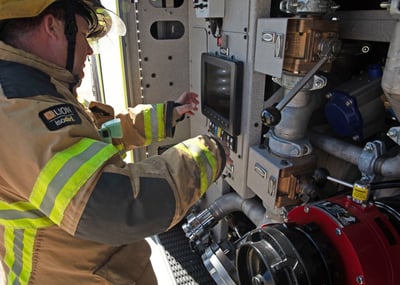
- Fixed-orifice systems (poppet or multi-metering manifold) may require physical modifications to accommodate F3 foam. Because of its higher viscosity, F3 foam can reduce foam flow through existing orifices—resulting in a lean (low-percentage) discharge if not properly adjusted.
- Electronic foam proportioning (EFP) systems, on the other hand, will adapt automatically. These systems continuously measure foam volume and adjust flow in real time, maintaining the correct concentration without any modifications.
Due to several foam manufacturing variables and truck variables, Oshkosh cannot accurately determine the correct orifice sizing prior to the transition, which is why testing must be done first. Oshkosh can then advise on adjustments based on the initial test results.
Learn more about the Oshkosh® ECO EFP™ system for ARFF foam proportioning.
Step 3: Foam Testing and Validation
 Once the system has been dialed in, the next step is validating that your ARFF vehicle is delivering the correct foam concentration with the new F3 foam. This includes a structured testing process that begins with measuring system performance and confirming proper foam proportioning across discharge points (refer to the FAA guidelines).
It’s also important to note that traditional testing methods were designed around AFFF, which has a viscosity similar to water. Because F3 foam is thicker, testing approaches may need to be adjusted to ensure accurate results. For instance, allowing more discharge time prior to taking discharge test samples.
ECO EFP Retrofit Kit
For departments looking to simplify the transition to F3 foam, Oshkosh Airport Products offers ECO EFP retrofit kits as an aftermarket upgrade for compatible ARFF vehicles.
Unlike traditional fixed-orifice systems, ECO EFP uses electronic controls to continuously monitor and adjust foam flow in real time. This allows the system to accommodate the higher viscosity of F3 foam, maintaining accurate foam concentration without the need for possible mechanical modifications.
In addition to improving proportioning accuracy, ECO EFP also supports:
- More consistent foam performance across discharge points
- Reduced foam waste during testing and operation
- Improved confidence when validating system performance with F3 foam
Prior to installation, the Oshkosh Technical Support Team will review your vehicle’s specifications to ensure compatibility. ECO EFP retrofit kits are available for select Striker® ARFF vehicles, including those currently equipped with poppet or existing EFP systems.
Once confirmed, the retrofit process provides a streamlined path to modernizing your foam proportioning system, helping your department transition to F3 foam more efficiently.
Your Partner in the F3 Foam Transition
Transitioning to F3 foam doesn’t have to be a complex or uncertain process. The Oshkosh Technical Support Team and Dealer Network are here to support you through the transition.
Whether you're working with a single ARFF vehicle or an entire ARFF fleet, the Oshkosh Technical Support team brings the expertise needed to help streamline the process and minimize downtime. Combined with solutions like ECO EFP retrofit kits, we are here to help your department confidently transition your ARFF vehicles to F3 foam.
Reach out to your local dealer to learn more about how we can support your transition to F3 foam or to start designing a new ARFF vehicle.