.webp)


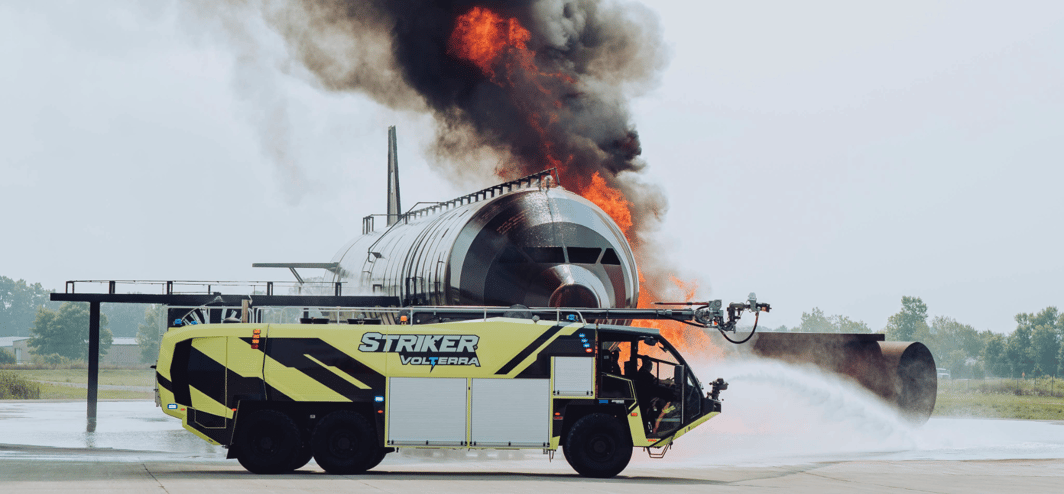
Every fire emergency is different and may require various firefighting tools and strategies to safely and successfully save lives and limit damage to property and the environment. In addition to using the necessary fire trucks and other equipment, the proper firefighting agents must be used depending on the type of fire being suppressed.
Fires are categorized into five classes - A, B, C, D and K, based on what type of fuel is involved. Each class requires specific firefighting agents to effectively control and extinguish the flames.
This article discusses the different types of agents available and how they are used by Aircraft Rescue and Firefighting (ARFF) trucks in an airfield environment.
Fire Classification
Firefighters learn about the five classes of fire and what firefighting agents are most effective at suppressing each one. Different classes of fire may require different firefighting chemicals to safely and effectively be extinguished.
While fire classes (A, B, C, D and K) are widely recognized, ICAO guidance focuses heavily on Class B flammable liquid fires, such as jet fuel, which represent the primary hazard in aviation incidents.
Types of Firefighting Agents for ARFF Fire Suppression
Water
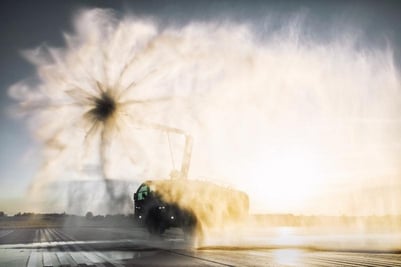 Using water for firefighting is the most common and recognizable method of suppressing fires. This simple agent is very effective in fighting class A fires, which are fueled by ordinary combustible materials. Many residential and commercial structures use and contain these materials making water very efficient in these environments. However, water is ineffective against class B and class C fires, which is most common at an airport emergency scene.
Airport firefighters are required to control and extinguish fires involving highly flammable jet fuel. Water could potentially make this type of fire worse because fuel will rise to the top of the water, enabling it to continue burning and spread as the water moves. Firefighting agents are required to suppress these types of fires, but water may still play a role. It is often mixed with the agents and used as a propellant to deploy the additional agents onto the fire.
Firefighting Foam
Firefighting foam was invented in the early 1990s and has evolved into various forms for different types of fires. Class A foam was originally made for use against forest and wildfires and is used against class A fires.
Class B foam is designed for class B fires, and ARFF foam is part of this category. It has a low viscosity and is able to cover large amounts of spilled or burning jet fuel in a short period of time. The foam allows firefighters to coat the materials burning or are at risk of burning, which cuts off the oxygen supply a fire needs. Class B foam is also designed to contain the explosive vapors produced by flammable liquids, particularly the jet fuel ARFF trucks may encounter at an airfield.
Internationally, firefighting foam used in ARFF operations must meet ICAO performance standards. ICAO defines foam performance levels (such as Level A, B or C) and specifies minimum application rates and effectiveness for extinguishing aviation fuel fires. These standards ensure that foam systems can rapidly control and extinguish high-risk jet fuel fires while preventing reignition. These guidelines also emphasize routine testing, typically at least annually, to verify proper foam proportioning and system performance.
Fluorine-Free Foam (F3)
In early 2023, the U.S. Department of Defense (DoD) released a new fluorine-free foam (F3) specification. Designed as a PFAS-free firefighting solution for Class B fire applications, F3 provides airports and ARFF departments with an alternative as the industry continues transitioning away from legacy Aqueous Film-Forming Foams (AFFF) toward more environmentally responsible options that eliminate PFAS “forever chemicals.”
Oshkosh Airport Products is well positioned to support this shift. The Oshkosh® ECO EFP™ System integrated into the design of Striker® ARFF vehicles is designed to accommodate F3, with the pumping and proportioning system expected to require little to no change, simplifying the transition for departments evaluating new firefighting foam options.
Dry Chemicals
Dry chemicals offer firefighters another option for attacking different classes of fire. The Striker ARFF offers water and foam deployment as standard options, while dry chemical is a specified option on the vehicles. They are primarily made from potassium and sodium bicarbonate, and ARFF trucks can carry several different types:
- ABC chemical
- BC chemical
- Purple K
 Dry chemicals are frequently used in industrial or airfield settings, where chemical and electrical fires are most likely to occur, which includes an airport environment. The suppression agent can be deployed using pressurized nitrogen or introduced to the water stream, which can carry the firefighting agents to the target area.
ABC chemical is the most versatile and can be used to suppress all types of fires. It is yellow in color and particularly effective on combination fires. BC chemical refers to an agent suitable for class B or C fires and is blue in color, and a free-flowing, non-abrasive water repellent which produces no toxic effects.
Because of its fast extinguishment properties on flammable liquid fires, Purple K is typically used in high hazard risk areas such as oil refineries, service stations, naval warships, power plants, airports and other places where large volumes of flammable liquids are handled.
Clean Agents
Some firefighting agents used in ARFF fire suppression, such as certain types of foam, can contain substances which may have a negative impact on the environment. Dry chemicals are only used when necessary due to the fine particulates which can spread easily over a large area. Cleanup of these agents can be costly and time-consuming.
For this reason, clean agents can help mitigate potential environmental harm while still safely and effectively suppressing fires. Clean agents are gases and work by removing the oxygen from the air around the fire. They are useful for electrical and engine fires, and because they are gas, they won’t further damage the materials being extinguished.
The Striker ARFF can be built to carry all types of fire suppression options, allowing crews to quickly switch between various types of firefighting agents. As the industry continues to evolve, newer firefighting agents such as fluorine-free foam (F3) are being introduced to help reduce environmental impact while maintaining effective fire suppression capabilities.
Oshkosh® ECO EFP™ System

Testing is essential for ARFF crews to ensure efficiency when faced with a real emergency scenario. In testing situations, firefighting agents can present unnecessary environmental risks and cleanup costs. Oshkosh Airport Products’ innovative electric foam proportioning system, named the ECO EFP system, allows for the testing of a vehicle’s foam system to determine if the system is properly proportioning, without requiring foam to be discharged from the vehicle. It measures both the solution and foam flows on the vehicle and archives the testing data with a time and date stamp. This reduces the environmental impact of foam testing and reduces the cost of cleaning up the foam solution after the test. The ECO EFP system can be installed on a vehicle already in service. Get in touch with a expert to learn how.
The Federal Aviation Administration (FAA) has approved the ECO EFP system to be used for testing and training purposes. The system shows the truck is working as it is intended without having to expel a foam agent.
Training for ARFF Fire Suppression
Knowing which firefighting agent to use and when to use it is a crucial part of training for all ARFF crews. In the United States, the FAA requires a specific curriculum for airport firefighters. The training is repeated each year as part of a recertification process. Globally, ARFF training programs are often aligned with ICAO recommendations.
Are you ready to learn more about Oshkosh Airport Products ARFF trucks and the various fire suppression agents used in airport emergency scenarios? Contact our team today or post a question in the comments below.